
Beam Deflection in Dipole and Quadrupole Magnets
Pole polarity, coil current, and +ve ion paths for dipole bends and X-focus quadrupoles, with links to rigidity maths and Magnetics.
Dipole magnets bend charged beams; quadrupole magnets focus them. These two sketches show the usual pole polarity, coil current sense, and the path of positive ions so you can read a magnet layout drawing without guessing which way the beam will go.
For the rigidity, bend radius, and deflection-angle maths behind a rectangular dipole, see Some Useful Formulae for High Energy Ion Beam Systems. Pyramid ships dipoles, quadrupoles, and related power systems under Magnetics.
Dipole
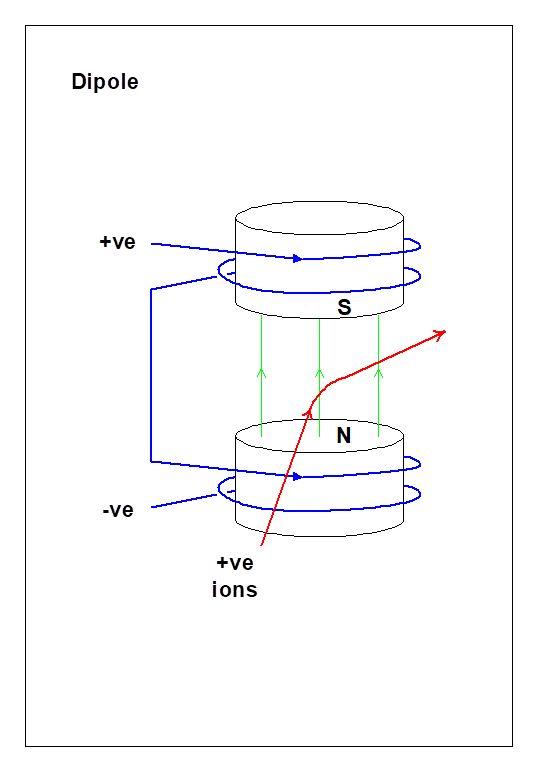
A classic dipole is two poles of opposite polarity facing each other across a gap. Field lines (green) run from N toward S. With the coil current sense shown (+ve / -ve on the blue windings), a beam of +ve ions entering the gap is deflected sideways (red trajectory).
Use a dipole when you need a bend, a spectrometer, or a closed orbit segment. Field uniformity and edge angles set how cleanly the bend matches the design radius from rigidity and .
X-Focus Quadrupole
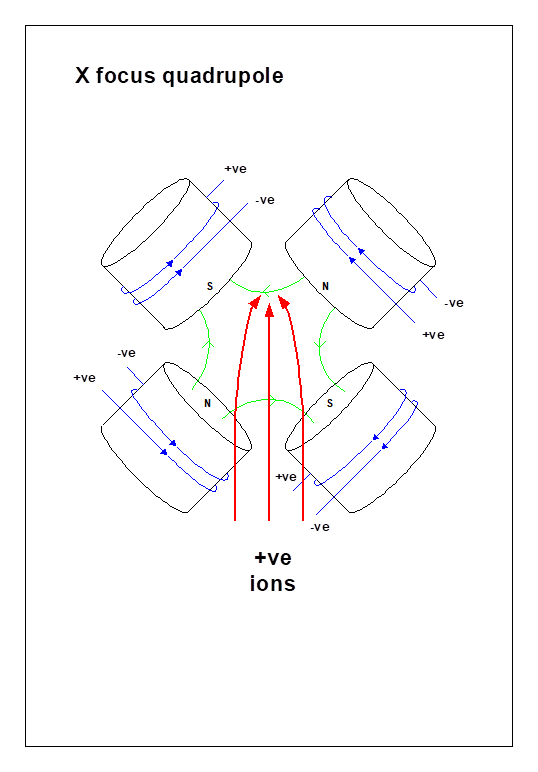
A quadrupole uses four poles in an alternating N-S-N-S pattern around the beam. In the orientation labeled X focus, rays that are off-axis in the horizontal plane are pushed back toward the center (outer red paths curve inward; the on-axis ray stays straight).
A single quadrupole focuses in one transverse plane and defocuses in the other. Beamlines therefore alternate focusing and defocusing quads (FODO and related lattices) so both planes stay controlled. Match polarity and current sense to the drawing: reversing all currents flips which plane focuses.
Putting It Together
| Magnet | Job for +ve ions | What to watch |
|---|---|---|
| Dipole | Bend / steer | Gap field direction vs entrance trajectory |
| X-focus quadrupole | Focus in X (defocus in Y) | Alternating poles; pair with a Y-focus quad downstream |
When you size magnets for a real energy and species, start from momentum and rigidity (ion-beam formulae), then choose dipole field or quadrupole gradient from the catalog under Magnetics. For help matching a nozzle, beamline, or power supply to these layouts, contact us or open Support.